Focus ROMI.HR
/
 Property: RNV
 And saw again, as I had seen at dawn,
The hollow pit which yesterday we dug;
I strained my hearing and at last it came —
That sudden flat sound as each victim fell —
Knife-edged, my thought itself began to tell
The forty-nine before me, known so well.
These lines belong to Ivan Goran Kovačić. His poem - Jama - gives a vivid first-person testimony of a man that became a victim of war, was tortured and thrown into a mass grave. Kovačić, a Croatian writer who fought alongside the partisan resistance movement during WWII, describes a dehumanizing experience, atrocities of war, and the disappearance of identities into pain. Therefore, it is no surprise that we find the verses of Jama engraved on the plaques of the Jasenovac Memorial Site.
Sometimes called the "Auschwitz of the Balkans", Jasenovac concentration camp became the main site of execution of the Ustasha state in the years 1941- 1945. During the second world war, the Ustasha regime, replicating many Nazi policies, targeted three main groups of people: Serbs, Roma, and Jews.
Jasenovac is one of those places that has reduced unbearable human suffering to a couple of numbers and has left us with not much but fields of mass graves. 39,570 men, 23,474 women, 20,101 children. These are the numbers of the victims who could be identified by name. The exact casualties are to this day unknown. Learning about this, it is difficult to imagine that these stories are more than just sad tales. Sometimes we may even avoid the deeply disturbing thought that this was the reality that consumed so many people’s lives. People that had family and friends, dreams and fears, people that were proud and vulnerable, people like you and me. Sometimes maybe we would rather not let these stories near us, just as we do with some of the most sensitive and painful past episodes from our lives. As if neglecting them could magically erase the unresolved suffering and prevent it from coming up to the surface.
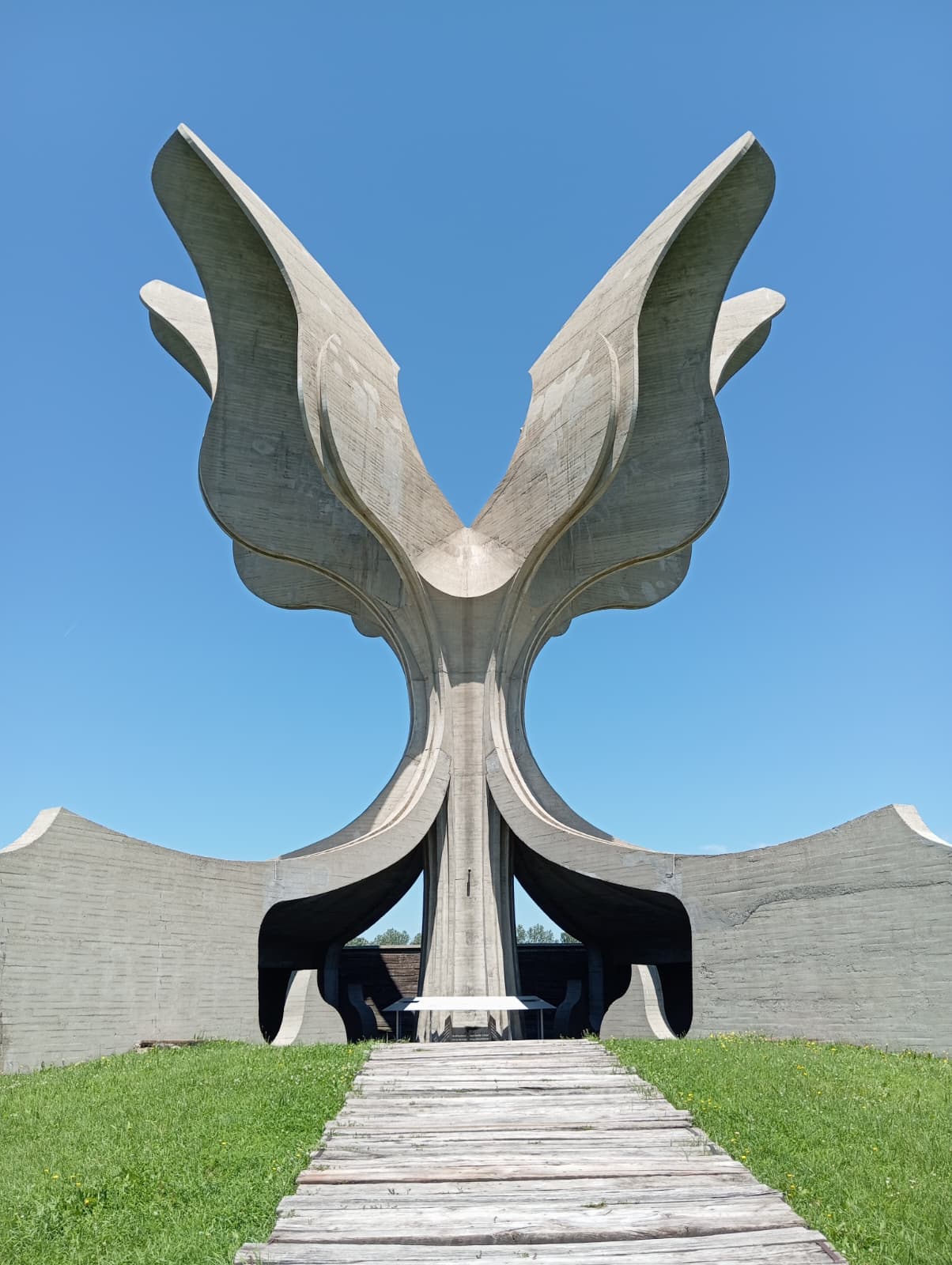
If you visit Jasenovac Concentration Camp on a sunny day in summer, you’ll see a beautiful landscape, the greenest grass and a stone flower monument done by a Serbian architect Bogdan Bogdanović. At a first glance, nothing screams: “several decades ago this used to be the biggest concentration camp in this part of the world”. But do we really have to think about these things? They happened such a long time ago (even though a century is a drop in the ocean in a historical context). It involved people that we seemingly have nothing to do with.
Researchers, scientists, or just curious people have long observed the similarities between micro and macro structures in the world. Whether it’s a connection between patterns of human brains and webs of galaxies, or individual consumer behaviour and market trends in economics, we can definitely find some interesting and useful information while comparing elements of different scales and domains.
What if we try to understand the historical atrocities based on some of the fears and insecurities that are so familiar to us? For instance, have you ever feared that a friend or people around you would disappoint or betray you? Hopefully, not as much as Joseph Stalin did. His anxiety eventually led to The Great Terror in the 1930s, killing hundreds of thousands. Have you ever felt competitive with your peers or siblings, trying to do everything to do better than them? Because it might have looked quite similar to the Cold War between the USA and the USSR, lasting for half a century and resulting in proxy wars and further suffering. And what about the FOMO - the fear of missing out? Even though the term was recently made up and popularized by Gen Z, this irrational feeling of panic has always existed. We can find an example of it if we look back at the Klondike Gold Rush when the news of local miners finding gold drew thousands of people out of their stable homes to the remote regions of Canada, where most of them ended up with economic or psychological collapse.
Of course, the triggers of these events cannot be reduced to a single cause, although they surely explain a lot. Therefore, when it comes to something as important and dreadful as the historical episode involving three genocides against three distinct ethnic groups, it is vital to try and understand the ways of dealing with this trauma, both for the victims and the perpetrators. Confronting memories, allowing grief, identity rebuilding, and social reconnection. Whether it comes to a personal hardship or a mass suffering, these are some stages that should not be overlooked. Making sure that these terrible experiences are resolved in a healthy way instead of being accumulated into a next disaster is our collective responsibility as members of the human race.
 Back to Focus