Focus ROMI.HR
/
ROMA IN GEORGIA
 Property: RNV
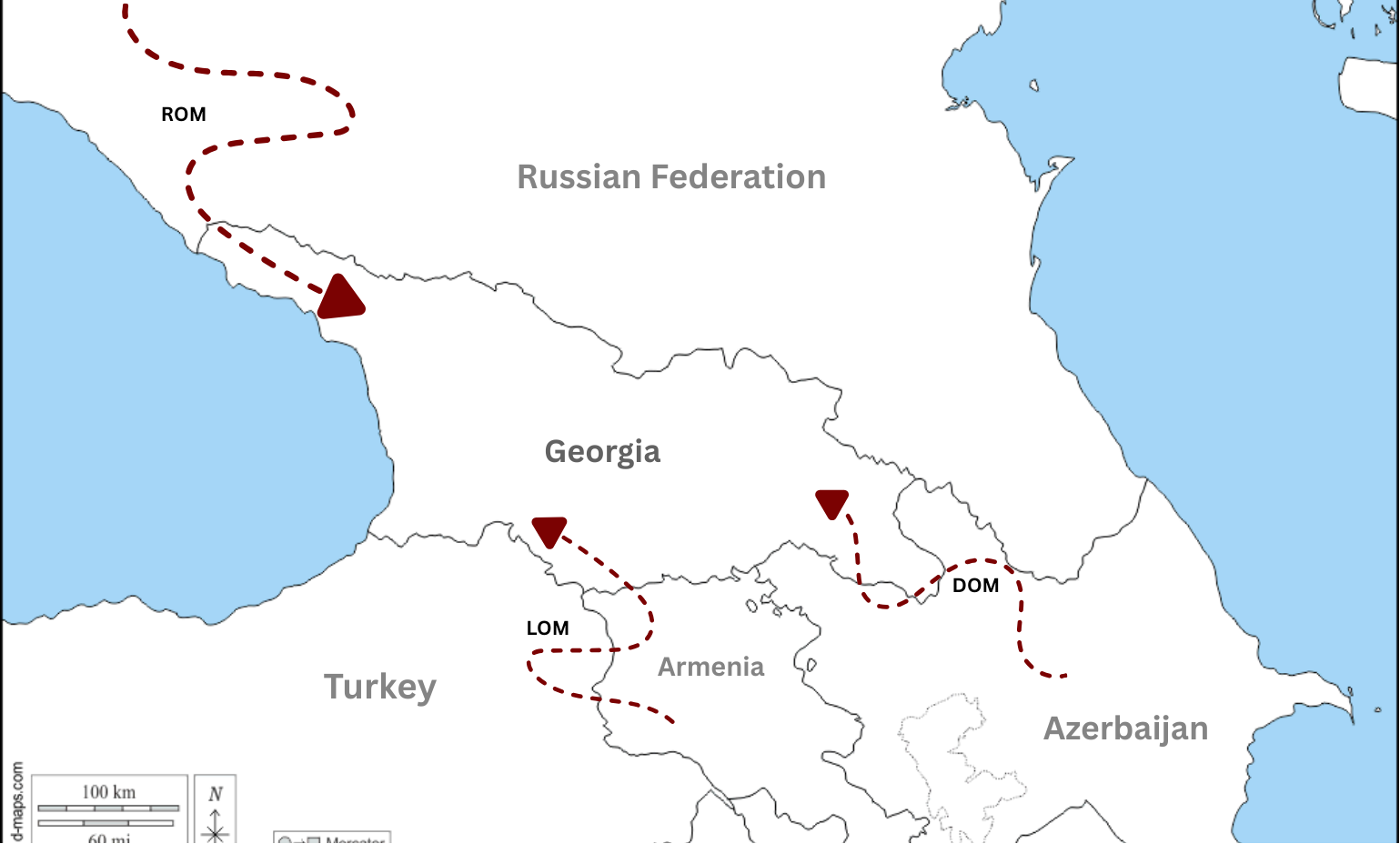
 Georgia is one of the few countries where you come across all the three main branches of Rom, Dom, and Lom communities. According to the official statistics from 2023, there are 604 Roma living in Georgia. Although, some NGO representatives assume that unofficially the numbers could reach 3000. The existence of variety of groups connected to Roma community helps us make assumptions about the migratory patterns of Roma’s ancestors.
Most studies agree that the Roma initially came from the northwestern part of the Indian subcontinent. There are different migratory routes that the Roma people could have taken in order to arrive to Europe. Some theories assume that they took the southern route through nowadays Iran. Some believe that the Roma followed the northern path through Central Asia. The others indicate the possibility of the mixture of the two.
Because of the lack of proofs, it is very hard to determine the initial arrival of Roma to Georgia or detailed information about their presence throughout centuries. Although, some documented evidence suggests certain migratory patterns of Roma from the neighbouring countries towards Georgia.
From the pre-history to the 11th century AD
The history of Georgia dates back to the pre-historical times. The scholars believe that the confederations of Iberia, Diauehi and Kolchis were home to proto-Georgian tribes starting from the end of the second millennium BCE. Even though Diaeuhi got destroyed in the mid-eighth century BCE, Kolchis and Iberia continued existing and at different times were dominated or influenced by several big powers, such as Assyria, Urartu, Greeks, Median and Persian Kingdoms. Parnavaz I (sometimes considered the first king of Iberia) is credited for establishing a united principality of eastern and western Georgian lands.
Throughout centuries the domination of Persia, Rome, Pontus, Arabs weakened the Georgian territories, however, a few important elements including the formation of the Georgian alphabet and the adoption of Christianity as a state religion strengthened the basis for the identity of the group. The 11th century saw the unification and the establishment of the Kingdom of Georgia under Bagrat III. Up till now, according to our sources, there is no mention of the Roma in this part of the Caucasus region.
The unified Kingdom of Georgia and history from the 11th to the 19th century
Despite some sources suggesting the presence of Roma people in Georgia since the 11th century AD, historical material regarding them is very limited. The experts give a few arguments to explain this shortage of evidence. One is the ancient way of conducting ethnographic studies that tend to neglect the ethnic groups without a homeland. The widespread illiteracy of the Roma also presents a challenge in defining an accurate account of history.
Till the end of the 18th century the Kingdom of Georgia went through the invasion of Turks, the Golden age, Mongol conquests, internal strife… For more than two centuries the western region of Georgia was taken over by the Ottomans, and the eastern region by the Persians. Some evidence suggests that in the Ottoman-dominated areas resided Gurbeti, a subgroup of Roma living in the other parts of Southeast Europe even today. Starting from the 19th century, the Russian Empire took over the control of the Georgian territory. From this point onwards, the presence of Roma people in Georgia has been increased, probably due to the significant population of Roma in the Russian empire in general and the easier movement possibilities.
The Russian Empire
A part of the Roma groups that has been living in Georgia for the longest are the Lom people (that the locals call “Bosha”). The Lom people denotes the ethnic sub-group that has a historical presence predominantly in Armenia where they migrated in around the 10th century. They present one of the more successful examples of integration into the local society. Therefore, their roots in Georgia are tightly connected to the Armenian movements into the country. After the Russo-Turkish war of 1828-29, as a part of the mass re-settlements of Armenians, many Lom people also moved to the region of Javakheti in Georgia that was a part of the Russian empire at that time. This represents one of the first instances of the mass migration of Roma to Georgian territory. Consequently, the Lom people in Georgia, and especially in the southwestern part of the country, speak the western dialect of the Armenian language, different from the eastern one that represents the dominant language in Armenia nowadays.
The Soviet takeover
After the chaotic developments of the October Revolution in Russia, the Democratic Republic of Georgia was established and declared independent in 1918. Following the Red Army invasion in 1921, Georgia was made part of the Union of the Soviet Socialist Republics. The Roma mobility increased in Soviet Georgia, where they came to seek financial or physical security at different times. The Soviet famine of 1930-33, following the forced collectivization of agriculture introduced by Joseph Stalin, led many to flee the areas most harshly affected by the campaign. Roma from Ukraine and other major grain-producing regions migrated towards the places with relative stability including Georgia.
An important branch that was affected in several ways during the initial phases of the USSR and later the World War II were the Crimean Roma. This group consisted of the Roma that lived on the Crimean peninsula together with the Crimean Tartars. Their origins are unclear but researchers offer several suggestions. According to Lev N. Cherenkov, a Russian Roma scholar, after the Russian takeover of Bessarabia in the 19th century, the Ursari Roma living on the occupied lands started migrating to Crimea, laying the foundations of the new subgroup. Other sources suggest the presence of Roma on the peninsula as early as the 15th century. In all cases, under the strong influence of the Tartars, the Crimean Roma adopted Islam and the Tartar language either partially or completely, resulting in new Crimean Romani dialects.
The famine in the early 1930s forced the Crimean Roma to escape their home conditions and some of them came to Georgia. The years 1942-44, Nazi occupation of Crimea, brought harsh repressions of this community, who became the victims of the Nazi policy of the Roma genocide. Some of them managed to escape death, but were later targeted along with the Tartars by the Soviet authorities for supposedly aiding the Nazis during the occupation.
Their descendants comprise the group of Krimuriya Roma that reside in the western part of Georgia and follow Islam. Because of the territorial and religious differences they have limited contact with another branch of Roma – Vlaxi – who live in the east of Georgia and practice Christian Orthodoxy. Vlaxi, including Kalderash – one of the subgroups of Vlaxi - is thought to have arrived from Moldova, migration similarly triggered by the famines in the southern USSR and the invasions of the WWII.
Independent Georgia
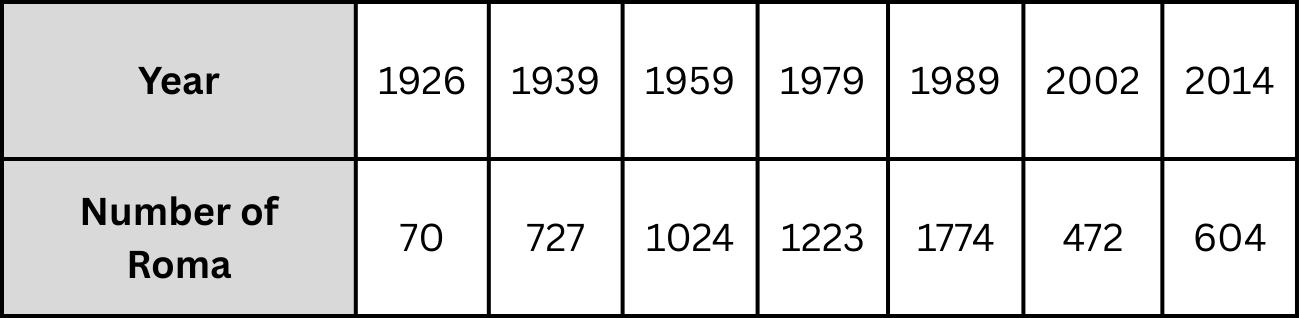
Georgia was part of the Soviet Union until 1991. Since then, the demography of the Roma people has changed substantially. The fall of communist regime left many Roma unemployed in the post-Soviet space. The 1990s marked big emigration waves not only among Roma but the Georgian population in general. Most of Roma have migrated to the North, to the Russian Federation in search of better economic opportunities. The number of self-declared Roma has gone down from 1774 in 1989 to 472 in 2002. The armed conflicts in the territory of Abkhazia and South Ossetia and the nationalist mobilization in the country in the 90s have influenced the migratory patterns of Roma in the region.
On the other hand, the Dom people have arrived to Georgia mostly from Azerbaijan after the collapse of the Soviet Union. They identify as Azeri Kurds or Kurdish Dom, but they distance themselves from other Kurds or the Roma people. The Roma also don’t consider the Kurdish Dom a part of their community because they speak another language - Kurmanji, the most widespread Kurdish dialect. Dom’s migration is part of their cross-border labor mobility in the regions of Eastern Europe, Caucasus, and Central Asia. They consider the Turkish Domlar a part of their community with whom they have established links after opening the borders with the collapse of the USSR.
The origins of Rom, Lom, and Dom populations in Georgia are, unfortunately, unclear. Throughout centuries they might have migrated to this region in search of security and financial stability, or as a part of their lifestyle. The analysis of the living memory of the Roma, the study of the variations in their spoken language, and the documented sources are vital for preserving the history and the culture of the community.
Photo Gallery:
 Back to Focus