Focus ROMI.HR
/
 Stock image
 The text aims to shed light on the Boyash community, focusing on their linguistic heritage, regional presence in Croatia, and the ongoing efforts to preserve their language in the face of educational and institutional neglect.
The Boyash are one of the Roma communities dispersed throughout Serbia, Croatia, Hungary, Bosnia and Herzegovina, Bulgaria, smaller number of them live in Macedonia, Greece, Ukraine, Slovakia and Slovenia.
People belonging to the Boyash community don’t speak Romani, the vast majority of them are either bilinguals (Boyash and local languages) or native speakers of local languages. It’s vital to note here that the Boyash language is not a dialect of Romani or somehow related to it. Romani belongs to Indic languages and Boyash is close to Romanian language (to avoid confusion, Romanian is a language spread on the territory of modern Romania), some linguists consider Boyash as “archaic Romanian”. Originally the Boyash people were forced to settle near the mountain range in Transylvania (nowadays Romania), where they were kept as slaves, and from here they moved to other parts of Europe.
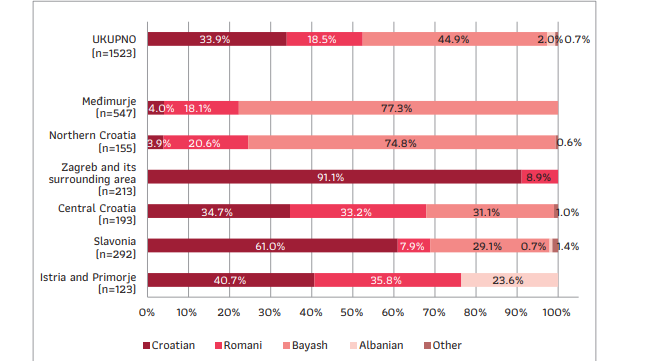
In Croatia the Boyash people mostly live in the counties of Međimurije (in the localities of Pribislavec, Čakovec and Kotoriba) and Baranja (Darda, Beli Manastir and Torjanci). It’s important to note here that Boyash is the second popular language of Roma in the localities after Croatian (according to the research “Roma inclusion in the Croatian society: identity, social distance and the experience of discrimination” conducted by N. Rašić, D. Lucić, B. Galić, N. Karajić).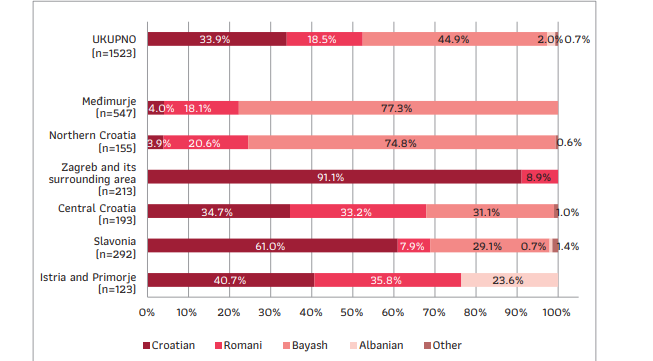
“Roma inclusion in the Croatian society: identity, social distance and the experience of discrimination” conducted by N. Rašić, D. Lucić, B. Galić, N. Karajić
Variant of the Boyash language spoken in Croatia is barely studied by linguists and ethnologists. The main solid work was published in 1996 by Nicolae Saramandu, a Romanian dialectologist. In addition, Saramandu created a corpus of 33 texts, which are phonetically transcribed conversations with local interlocutors. However, there is still a lack of studies of Boyash spoken in Croatia, although the Boyash make up a significant percentage of the Roma minority.
Based on subdialectal features of the Boyash language, speakers identify themselves either as Munteni (mostly in Baranja), or Ardeleni (mostly in Međimurje). In addition to the geographical factor, there is also a cultural one, since the Muntenians are mainly Orthodox Christians, while the Ardelens are Catholics. Munteni-Ardeleni division is still mainly linguistic: disappearance of initial v in Ardeleni (órbă and Rom. vorbă ‘word’); Munteni preserved imperfect (past progressive verb tense), while many Bayash dialects lost most of the past tenses; in Ardeni an archaic form of indefinite article is used much more rarely than in Munteni. The list of differences between the dialects of Baranja and Međimurje is very short, but it is still very indicative, since Boyash is rather a general name for a group of variants of the same language, which differ significantly not only from country to country, but also from region to region.
The big problem is that Boyash schoolchildren do not study their language in schools, at most they speak Boyash at home with their families, therefore they cannot write or read in this language, because the school curriculum does not provide for this. Bayash already experiences a lack of written texts and learning materials but the current situation promotes positive change.
Nevertheless, individual researchers and activists together with NGO started to draw attention to Boyash. A quite recent example is that handbook for learning Boyash Romanian and Boyash Romanian-Croatian dictionary containing around 300 words were written by Petar Radosavljević, professor of University of Zagreb. In Međimurje workshops of basic Boyash were organized for teachers working with Boyash students, at least that’s what local newspapers reported.
Despite their long-standing presence and distinct linguistic heritage, the Boyash remain underrepresented in both academic studies and national education systems. The lack of institutional support for their language has led to diminished literacy in Boyash among younger generations, particularly in Croatia. However, recent efforts by individual researchers and local communities offer hope for cultural and linguistic revitalization. Initiatives like educational handbooks and teacher training workshops signal a growing awareness of the need to preserve and support the Boyash identity, ensuring it continues to thrive in the face of historical and social challenges.
If you are curious to read more about the Boyash people or its language, you may refer to the sources used for writing this article:
- Annemarie Sorescu Marinković, THE BAYASH IN CROATIA: ROMANIAN VERNACULARS IN BARANJA AND MEDJIMURJE.
- Nikola Rašić, Danijela Lucić, Branka Galić, Nenad Karajić, ROMA INCLUSION IN THE CROATIAN SOCIETY: IDENTITY, SOCIAL DISTANCE AND THE EXPERIENCE OF DISCRIMINATION.
- Iva Varga, TEACHING ENGLISH AS THE THIRD LANGUAGE: THE CASE OF YOUNG BOYASH ROMANIAN SPEAKERS IN CROATIA
Photo Gallery:
 Back to Focus