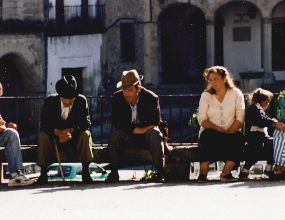
 Source: Wikimedia Commons.
 Caló, the Roma language spoken in Spain, has endured centuries of marginalization, discrimination, and forced assimilation. Denied official recognition and excluded from schools and public policies, it survives largely within families and communities, carrying the memory, identity, and resilience of the Roma people in the face of persistent social exclusion.
Language has always been one of the first targets of oppression for the Roma people, whose history in Europe is marked by exclusion, poverty, and systemic racism. Words, after all, are not just a way of communicating but a means of preserving culture and transmitting memory. Across the continent, Roma communities have developed and preserved a variety of languages: from Romani dialects rooted in Indo-Aryan origins, to para-Romani varieties like Caló in Spain or Boyash in Romania, Serbia, Croatia and Hungary.
These languages are not simply linguistic systems; they are acts of survival. Yet in country after country, they have been repeatedly silenced or ignored. Roma children were often punished for speaking their mother tongue in schools, where it was treated as a sign of dirtiness, primitiveness, or unworthiness. Rather than embracing multilingualism, states imposed forced assimilation, framing it as integration. The result was devastating: generations of lost languages, broken transmission between parents and children, and a deep sense of shame attached to one’s own identity.
During the Middle Ages, the situation of Roma communities across Europe was far from uniform, reflecting the complex political and social landscapes of the time. In some kingdoms, Roma were actively expelled, their movements restricted, and their languages banned as authorities sought to control or remove groups considered “outsiders.” These measures were often justified by fears of rebellion, criminalization, or the perceived threat of cultural difference. In contrast, other regions paid little attention to the languages Roma spoke, focusing instead on their economic or social roles within society.
In parts of the Balkans, and particularly in Romania, Roma were subjected to centuries of slavery. They were denied basic freedoms, and strict controls were imposed over their daily lives, family structures, and cultural practices. Speaking their native language or organizing autonomously was often forbidden, as local rulers feared that any sign of independence could lead to revolt. Under these conditions, maintaining their linguistic heritage became a dangerous act, with severe consequences for those who resisted assimilation.
The rise and decline of Caló
In Spain, where the Roma or Gitanos (traditional name used in Spain towards Roma people) have lived for more than 600 years, the most striking example of linguistic silencing is the decline of Caló. Caló is a para-Romani variety that preserves Romani vocabulary but uses Spanish grammar, a hybrid form born when the Roma in Iberia gradually shifted toward the dominant Romance languages while retaining a significant Romani lexicon. It functioned not only as a language of communication but also as a shield, allowing Gitanos to preserve community identity in hostile environments. Over centuries, however, Caló was eroded, not by natural evolution but by deliberate policies and social exclusion.
When Roma began arriving in Spain in the late Middle Ages, they entered a society structured by rigid hierarchies, regional kingdoms, and a strong sense of social order. Their arrival coincided with a period of consolidation of the Spanish kingdoms, where conformity to Christian norms and obedience to local authorities were highly valued. From the beginning, Roma were perceived as outsiders: their language, customs, and mobility made them suspicious in the eyes of authorities and local populations.
Assimilation pressures, both formal—through laws and administrative controls—and informal—through social stigma and community exclusion—discouraged the use of Caló and other Romani dialects. Schools and early educational settings often punished children for speaking their mother tongue, while broader society equated Roma languages with backwardness, deviance, or even criminality. Over time, these pressures contributed to the gradual erosion of their original languages, as survival increasingly depended on adopting the dominant Spanish language while retaining fragments of Romani vocabulary within families and communities as a quiet act of cultural preservation.
These historical circumstances help explain why, centuries later, Caló exists primarily as a para-Romani variety rather than a fully preserved Romani language. The combination of medieval oppression, slavery in Eastern Europe, and systematic assimilation in Spain set the stage for a linguistic shift that continues to affect the Roma community today.
Franco’s Dictatorship and the Politics of Invisibility
The Franco dictatorship accelerated this process. From 1939 to 1975, Franco’s regime systematically repressed Spain’s linguistic diversity. Catalan, Basque, and Galician were banned in public spaces, and speakers were humiliated, fined, or imprisoned for using them. Yet those languages at least retained some prestige and, after Franco’s death, regained their place in public life. Today they enjoy co-official status, are taught in schools, and benefit from cultural institutions dedicated to their preservation. Caló, in contrast, was denied recognition altogether. It was ignored by linguists, politicians, and policymakers, even those who fought passionately for minority languages. In effect, Caló was treated as if it had never existed. Its speakers were not only silenced; they were made invisible.
The consequences are still visible today. Caló is spoken by an estimated 65,000 to 170,000 people, scattered across Spain, Portugal, France, and even Brazil. But true fluency is rare. A study in Andalusia showed that Roma respondents recognized on average just over one hundred Caló words out of a list of 355. Younger generations often recognized fewer than eighty. What survives is often fragmentary: a handful of words used at home, lullabies passed down by grandparents, expressions deployed as cultural markers but not as part of daily communication. Caló lives on as a language of memory and resilience rather than one of full functionality.
The Absence of Legal Protection
What makes this loss more troubling is the state’s continued neglect. Spain has ratified the European Charter for Regional or Minority Languages, which should, in theory, protect languages like Caló. But the protection mechanism only applies to languages explicitly recognized in the Statutes of Autonomy of Spain’s autonomous communities. Catalan, Basque, Galician, and even Aranese have secured such recognition. Caló, however, has not. No Spanish region or even the central Government has listed it, and thus it falls outside the Charter’s protections. Unlike in Hungary, Slovakia, Bulgaria, or Romania, where Romani is legally recognized as a minority language, Spain does not extend such recognition to Caló. France and Portugal also refuse to protect it. The result is institutional silence: no schooling in Caló, no cultural programs, no state-backed documentation projects, and no public broadcasting.
This invisibility is not accidental but the product of centuries of stigma. Caló has long been framed as a “non-language,” a mere collection of slang words, not worthy of preservation. This dismissive attitude has been internalized not only by mainstream society but sometimes by Roma themselves, who have been made to feel ashamed of speaking it. In this way, linguistic oppression has achieved what it set out to do: to break the continuity of Roma culture by severing its transmission across generations.
Between Decline and Possibility of Revival
And yet, Caló continues to matter. Even in its fragile state, it represents an archive of memory and a testament to survival. It appears in flamenco lyrics, in family sayings, in coded conversations meant to affirm identity in the face of hostility. Losing Caló entirely would mean losing part of Spain’s cultural history, not just that of the Roma. It would mean accepting that a community’s linguistic heritage can be erased without consequence.
The challenges of revitalizing Caló are immense. There is no standardized orthography, documentation is limited, and intergenerational transmission is weak. But revival is not impossible. Other languages that were once considered doomed — Welsh in the UK, Basque in Spain, — have been revitalized through determined community action, state support, and cultural pride. For Caló, the first step is recognition: acknowledging that it exists, that it is a language in its own right, and that it deserves protection under national and European frameworks. From there, initiatives such as community schools, cultural projects, music, and media could help restore both knowledge and prestige.
Caló’s decline is not the result of apathy or inevitability; it is the direct consequence of neglect and discrimination. To reverse that decline requires not only institutional support but also a broader reckoning with the way Roma communities have been marginalized for centuries.
Caló is not just a language —it is a story of resilience against erasure—. To let it disappear would be to accept, once again, that Roma culture can be silenced without protest. Preserving Caló would mean more than saving a vocabulary; it would mean affirming the dignity of a people whose voices have been ignored for far too long.