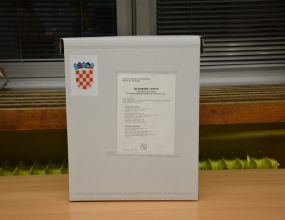
On January 12, 2025, the RNV team participated in the electoral process for the second turn of Presidential Elections. Our role was that of independent electoral observers, who are in charge of monitoring the whole voting process and to ensure that voters can freely express their political preferences in a secret, protected, and democratic manner. RNV was only one of two organizations of civil society that got accredited as independent observers for Presidential Elections from State Election Commission (DIP, Državno izborno povjerenstvo).
Croatia is a parliamentary Republic, which means that the Government derives its power and legitimacy from the Parliament, and that the Government is also held accountable by the Parliament. However, not all parliamentary republics are made the same, and one of the main elements of distinction is precisely the method chosen to elect the President of the Republic, and the roles and power given to the President.
All the rights and duties of the President of the Republic of Croatia are detailed in a specific section of the Constitution of Croatia, Articles 94 to 106. Accordingly, the President represents Croatia at home and abroad, ensures the well-functioning of the country, and is responsible for defending its independence and territorial integrity, for a five-year mandate that can only be renewed once. Moreover, duties include calling referendums and elections for the parliament, giving the mandate to form a new government to someone who enjoys the support of the majority of MPs, and cooperating with the Government in formulating and implementing foreign policy and diplomatic duties. Additionally, given the responsibility for the territorial integrity of the country, the President is also the commander-in-chief of the armed forces of Croatia.
The first electoral round for Presidential elections was held on December 29, 2024. Eight candidates were running for Presidency, representing very different political forces of Croatia, from green, progressive parties to conservative and sovereignist ones. In the end, no candidate got the majority of votes in the first round, and therefore the second round was organized. The two candidates for the second round were Zoran Milanović, incumbent President of Croatia since 2020, who was standing for a second (and final) mandate, and Dragan Primorac, former Minister of Science, Education and Sports. Both of them were formally independent candidates, but in reality, Milanović’s candidacy was supported by more than 10.000 signatures, along with the Social Democratic Party (SDP) and a plethora of centre-left and liberal parties. At the same time, Primorac also got more than 10.000 signatures, and he was supported by the Croatian Democratic Union (HDZ) and supported by various centrist and right-wing parties. HDZ also plays a major role in current Croatian politics, because Andrej Plenković, who has been Prime Minister since 2016, is the President of HDZ.
Therefore, on January 12, our exploration of Croatia’s electoral system and organization began. We visited a number of different polling stations, and met the members of various election committees. All people working in the committees were really polite and welcoming, and even those who were not fluent in English still did their best to try to answer our (numerous) questions. For example, we learnt more about the bureaucratic and preparation process that every member of an election committee must go through in order to be fully ready to deal with any circumstance that may take place during voting days. Indeed, they are asked to participate in some days of intensive training in which they are taught how the electoral system works, what are their rights and duties, and how to perform their job in the best possible way. Some other questions regarded their feelings on the general attitudes towards elections from voters, and if they had noticed any major difference in terms of turnout comparing the first and second round. We were also really curious about the dos and don'ts of voting: can voters bring their telephones into the actual polling station? How common is it for them to have to explain how to vote?
Of course, there was also room for a bit of fun: we asked if they remembered any peculiar comments on ballot papers from elections in the past, and they shared not only some of the interesting notes left by voters, but also how difficult it can be sometimes to decide if a vote should be counted as valid or not.
All polling stations closed at 19, and as part of our observer role, we got to stay in one polling station and attend the work of the electoral committee during the counting of ballots and the determination of voting results. The members of the electoral committee organized the last part of the job very efficiently: while some of them were counting and sorting the ballot papers, the president of the committee was making sure that the number of registered voters and ballot papers were equal. After double-checking all the voting material, the president of the committee wrote down in an official document the number of votes for each candidate, as well as the number of invalid and blank votes. The results coming from the polling station that was hosting us were perfectly in line with national trends: indeed, Milanović won that polling station, getting three times more votes than Primorac.
In general, this has been a remarkable educational experience, and for multiple reasons: first, we got the opportunity to get first-hand knowledge on how the electoral process works in Croatia; second, because we could talk directly with people who believe in the values of free, secret, and fair elections as a staple of democracy; and third, because this gave us a lot of food for thought, and led us to learn more about how voting works in the different countries from where we come.